By Mathias Eichler
Winter trails, darkness and all the weather - a fun holiday celebration at Olympia's amazing Squaxin Park. Registration open now.
Backyard Ultras (BYU) are booming. So we are told. Dan England wrote for Trailrunner Magazine a couple of weeks ago:
Put on the map by the likes of Courtney Dauwalter and mastermind Gary “Lazarus Lake” Cantrell, backyard ultras have no time cutoff and seemingly no end to their rise in popularity.
“Seemingly no end to their rise in popularity” so we are told. So I asked myself if I could put some numbers to it rather than just vibing it.
I reached out to Jay Kelley, co-CEO of UltraSignup (USU) and asked if their team could provide some actual numbers. USU hosts registrations for about 75% of trail races in the U.S., surely they should get us more than “look how my Instagram follower numbers grew” to explain just how hot Backyard Ultras are.
According to USU:
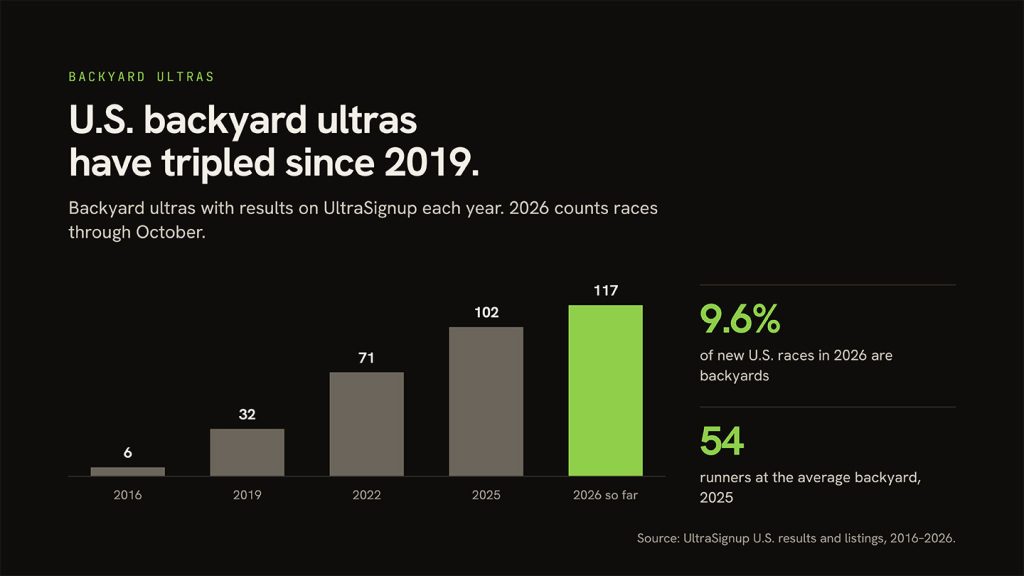
102 U.S. backyards posted results with us in 2025, up from 32 in 2019. There are 117 so far in 2026, 161 on our calendar for the full year, and 78 already listed for 2027.
How many total runners (more on this later):
Runners: backyard starts went from 1,469 in 2019 to 5,495 in 2025, and 2026 is already at 6,774. That’s more than 4× in seven years.
And a look beyond the borders of the U.S.:
Backyards worldwide (Big’s Backyard Ultra’s own figures): 787 races in 92 countries on its calendar as of Nov 10, 683 of them upcoming. We cited 776 in 91 countries at USTRC on Nov 7. 55,000 athletes ran one in the past year, and 4,396 of them went 24 hours or longer.
Brief comparisons here:
According to UTMB’s own figures 29,000 people registered (and had the qualifications!) for one of the UTMB World Series Finals lotteries this year.
And in 2025 the UTMB World Series hosted:
146,933 runners across 55 events, 266 races, 28 countries on five continents.
How many BYU are there – compared to “regular trail races” – on the USU platform:
…backyards are 5.5% of U.S. events with results in 2026 (4.2% in 2025), but only 2.7% of race distances, because about 4 in 5 backyard events offer just the one race. Among events with an ultra, they’re 7.6% (2.2% in 2019), and they’re 4.5% of ultra starters (1.0% in 2019).
Clearly BYUs are growing in popularity, but by my basic math that puts ~150 BYUs to about 5,000 overall trail races (not comparing it to events but individual races). That’s still a small number.
Things seem even smaller when you look at the average field size of an BYU:
…the average U.S. backyard drew 54 starters in 2025 and 58 so far in 2026 (medians 41 and 48). The biggest this year was Prairie On Fire in Indiana, with 228 starters, and 17 backyards drew 100 or more.
Only 17 BYUs in the U.S. (that were on the USU platform) had a field size of over 100 people. That’s not just for the race, but for the entire event, since most BYUs only have one race on offer – as supposed to a selection of race distances for a whole weekend of events – like most trail events nowadays.
If you’re an RD and look at these numbers you see the challenge. I asked about dollar numbers too, but USU declined to provide those. My feeling, and basic research is that entry fees to a BYUs are lower (for now!) compared to other trail races. Especially if you look at the average expectations of how long an event could go on for. Yes, they are also cheaper to run (I would wager): a single loop, no aid station, way fewer volunteers, permitting is simpler due to fewer miles of trails used. But unless you get a supplement sponsor I can’t see these events to be penciling out in the long run.
Clearly there is growth and interest here. I added a handy little chart USU provided me (This is a high honor, Jay. I usually don’t add graphics to my posts.) to visualize the growth and interest in the sport.
What fascinates me about this current conversation is that the last couple of years saw quite a decline in overall trail coverage on social media, especially on Instagram. Several top athletes, exhausted by the endless algorithm changes slowed down their postings, hibernated their accounts, and moved to Substack or other platforms. Traffic and engagement slowed way down. But most of the BYU growth conversation is on how an event, or runner participating in it, can use the fame (or notoriety) they achieve by being featured at a BYU as a way to “grow their following”, and “go pro” as a result.
Maybe this is the genius of Laz all over again. His events seem uniquely built (inadvertently I assume, given that he doesn’t directly court the media or sponsors) to “create characters”. Be it at Barkley, now the BYUs, or even in trail media where an outsized number of books and films are dedicated to either Laz himself, the events he created, or the athletes competing in them. Barkley coverage has always been catnip for mainstream media, and now BYUs are that for the influencer media space.
I’ve been asking and suggesting this for awhile now: The BYU, due to its controlled space and time format, would be quite well suited to become an Olympic sport. (After having seen what the IOC did with Skimo in Milano-Cortina earlier this year I am less inclined to believe this. While the Skimo events felt contrived as expected they were also shockingly short. I can’t see the IOC signing on an open-ended event that would go on for days.) But, the controlled and easy to film course, the repeatable drama on top of each hour, is perfect TV material. It could work.
Thinking about trail running becoming an Olympic sport we all already have conceded that whatever format the IOC will conjure up will feel like a far cry from what we consider trail running to be and enjoy about it. The Olympic version of trail running won’t be a long adventure run over challenging singletrack through a beautiful mountain-side. Trail going Olympic will be artificial, contrived, shortened, repeatable, and boring. But it will be broadcasted in 4K.
Therefore one might consider the BYUs as a reasonable format for the IOC to adopt. And maybe at the very least it will have come from within the sport, and not manufactured in a boardroom in Lausanne, Switzerland.
Currently trail’s top athletes (most well-known, most respected, most professional in terms of sponsorships and media visibility) aren’t running BYUs regularly. It is its own dedicated niche somewhat adjacent to our sport. One that is attracting endurance experts and media influencers. How this would change if a version of BYUs become an Olympic sport is a whole other question, and one many people are terrified to ponder.
One thing’s for sure though, once BYUs become an official Olympic sport there will be doping controls, and that too might be terrifying for some.
Thanks to Jay Kelley and the team at UltraSignup for providing me with the numbers for this article.
Sign up and never miss a story.

Electric Cable Car is a owned by Einmaleins and part of trail. run. film. Productions. ©2026. All Rights Reserved.